Best Email Finder Tools in 2026: Pick for Deliverability, Not Database Size
If 1 in 4 of your prospecting emails bounces, your domain reputation is already bleeding. This guide ranks the best email finder tools in 2026 by verified accuracy, not vanity database size, and shows you how to protect your sender score while building pipeline.
If 1 in 4 of your prospecting emails bounces, your domain reputation is already bleeding — and the best email finder tool is the one that stops it before it starts. The short answer: the strongest email finder in 2026 is the one that returns verified contacts, not raw guesses.
Apollo’s email accuracy sits around 73% in independent tests, which means roughly one in four addresses bounces, fails, or lands on the wrong person. That’s the difference between a reply rate that builds pipeline and a sender score that quietly tanks your whole sequence.
Most reps don’t lose deals because their copy is bad. They lose them because their list was rotten before the first send. This guide ranks the real options, shows you the pricing and accuracy numbers nobody puts on their homepage, and gives you a framework to pick the right tool today.
---
What Is an Email Finder Tool?
An email finder tool locates a verified business email address from a name, company, or domain — then confirms the inbox actually exists before you send. The good ones don’t just pattern-match first.last@company.com and hope. They run live SMTP checks, MX record lookups, and spam-trap detection so the address you export is one a human will actually read.
Think of it as the difference between a phone book and a phone that rings. A list of guesses is worthless if half the numbers are disconnected.
---
How Email Finder Tools Actually Work
Every credible finder runs the same four-step gauntlet. Knowing it helps you spot which tools cut corners:
- Syntax check — validates the address is even formatted correctly.
- MX record lookup — confirms the domain has a working mail server that accepts mail.
- SMTP verification — pings the recipient’s server and simulates a send without actually delivering anything, confirming the mailbox is live.
- Spam-trap detection — flags addresses planted specifically to catch and blacklist spammers.
Tools that skip live SMTP verification — or run it in batches days later instead of at lookup time — are where bounce rates climb. Apollo, for example, runs its verification layer periodically in batches rather than on every real-time lookup, which is part of why its accuracy trails finders that verify on the spot.
---
Why Accuracy Is the Only Metric That Matters
Volume is a vanity number. A database of 500 million contacts is useless if a third of them bounce. Here’s the math that should drive your decision:
- Industry best practice is to keep total bounces under 2% and hard bounces under 1%.
- Per HubSpot’s 2026 deliverability data, anything above a 5% bounce rate triggers automatic penalties from Gmail and Outlook — your good emails start landing in spam too.
- Legacy database providers that prioritize volume over freshness show bounce rates between 25% and 35%. Run a 1,000-contact list through one of those and you’ve torched your domain in a single afternoon.
At scale the gap compounds. At 99% accuracy across 500,000 addresses you get 5,000 errors. At 99.9% you get 500. That 0.9% is the difference between a healthy sender reputation and a Postmaster Tools nightmare.
The InboundLabs Verified-Yield Method
Don’t measure a finder by how many emails it returns — measure it by how many land.
Verified Yield = (emails that reach a real inbox) ÷ (credits spent)
- A tool that returns 100 emails at 73% accuracy gives you 73 usable contacts.
- A tool that returns 80 at 98% gives you 78 usable contacts — fewer credits burned, more pipeline, and no domain damage.
Optimize for Verified Yield, not raw hit count, and your whole outbound engine gets cheaper and safer at the same time.
---
The Best Email Finder Tools in 2026, Ranked
1. InboundLabs — Best for verified data at scale
InboundLabs leads on the metric that matters: deliverability. With 280 million verified B2B contacts and 98% deliverability, it returns emails that land — not guesses that bounce.
It also ships what most “email finders” don’t:
- Verified direct dials (real numbers, not switchboards)
- Buyer intent signals
- Firmographic data (company size, industry, tech stack, and more)
So you’re not just finding an inbox, you’re finding a buyer who’s already in-market.
No annual contract, free to start, and cleaner data than legacy providers at a fraction of the cost.
See how InboundLabs finds verified contacts instantly → inboundlabs.app
---
2. Hunter.io — Best focused finder for SMB domains
Hunter is the specialist’s pick. Independent testing puts its email accuracy at 90–94%, and its verification engine is one of the most trusted in the market — when Hunter says valid, it almost always is.
On small and mid-market domains, it delivers 14–18% more verified emails than Apollo.
Pricing:
- Shared credit pool from $34 to $299/month (depending on volume)
Trade-offs:
- It’s a finder and verifier, not a full outbound platform
- No native sequences or multistep campaigns
- No built-in intent data
If you already have an outreach platform and just need accurate emails, Hunter is a strong choice.
3. Apollo.io — Best all-in-one platform for SMB outbound
Apollo bundles an email finder, sequencing, and CRM enrichment into one platform. For teams that want everything in a single tool, that's genuinely useful. But the data layer has well-documented issues that matter when your domain is on the line.
Independent testing puts Apollo's email accuracy at 65-80% depending on the region. US contact data lands around 80-88% accuracy. Outside the US — EMEA and APAC especially — that drops to 60-73%. Bounce rates on Apollo-sourced lists regularly hit 15-25%, well above the 5% threshold where Gmail and Outlook start penalizing your sending domain.
Pricing:
- Free plan: ~50 email credits/month, 250/day send cap
- Basic: $49/user/month
- Professional: $79/user/month
- Organization: $119/user/month
Trade-offs:
- Data accuracy is inconsistent — strong in the US, weaker internationally
- Verification runs in batch cycles, not at real-time lookup — meaning what was accurate when verified may have decayed by the time you send
- Strong sequencing layer, but only as good as the data underneath it
Best for: US-focused SMB teams who want a single platform and can tolerate a higher bounce rate with proper list hygiene on top.
4. Cognism — Best for EMEA and phone-verified direct dials
Cognism is the most accurate option for European markets. Its "Diamond Data" tier phone-verifies numbers by a human before delivery — not just SMTP pings — which is why its phone hit rate (82%) is more than double RocketReach's (~38%) in head-to-head testing.
For teams selling into the UK, DACH, Benelux, or Nordics, Cognism's data quality is in a different tier from US-first providers. GDPR compliance is baked in, not bolted on.
Pricing:
- Typically $1,000-$3,000/month for small teams (custom pricing, no public list price)
- Annual contracts required
Trade-offs:
- High price point — not practical for early-stage teams or solo reps
- Annual contracts with limited flexibility
- North American coverage is good but not Cognism's primary strength
Best for: Revenue teams with serious EMEA coverage needs, enterprise sales orgs, or any team where phone accuracy is a top priority.
5. Lusha — Best for quick browser-based individual lookups
Lusha's browser extension is fast and clean. It surfaces emails and phone numbers directly on LinkedIn profiles and company websites without leaving the tab. For reps doing individual research, that workflow is genuinely fast.
Accuracy sits at 75-85% for email, 40-60% for direct dials — solid for tech companies with standardized email formats, weaker for smaller businesses and non-tech sectors. G2 reviewers note 127 accuracy complaints versus significant praise, with roughly a third of credits wasted on undeliverable or wrong-person data.
Pricing:
- Free: 5 credits/month
- Pro: ~$29/user/month (annual)
- Teams and Business tiers scale from there
Trade-offs:
- Credit-based model means costs scale fast for high-volume prospecting
- Weaker for bulk list building compared to database-first tools
- Direct dial accuracy significantly lower than email accuracy
- No native sequencing or outreach layer
Best for: Individual reps and SDRs doing targeted research one contact at a time, or teams supplementing a primary database with a secondary lookup tool.
6. RocketReach — Best for broad coverage across non-standard roles
RocketReach indexes 700 million+ profiles — one of the largest raw coverage numbers in the market. For finding contacts in industries or roles that mainstream databases underindex (non-profits, academia, government, creative industries), RocketReach often surfaces results others miss.
The accuracy trade-off is real. G2 reviewers flag "inaccurate data" 115 times and "outdated contacts" 111 times. Phone number hit rates run around 38% — useful as a secondary source but not reliable enough for a calling-first workflow.
Pricing:
- Individual plans: $80-$300/user/month
- Team plans: from $83/user/month (annual)
Trade-offs:
- Data freshness is inconsistent — strong coverage but higher staleness rate
- Phone accuracy significantly lower than email accuracy
- No native sequences or outreach tooling
Best for: Researchers and teams prospecting into less-covered verticals where breadth matters more than precision. Use as a secondary source alongside a primary verified database.
7. ZoomInfo — Best for enterprise with existing investment
ZoomInfo is the market leader by revenue and brand recognition. Its US enterprise coverage is strong, and the platform integrates deeply with Salesforce, HubSpot, and major sequencing tools. For companies already in the ZoomInfo ecosystem with long-term contracts, it delivers.
The problem is cost and flexibility. Annual contracts start at $15,000-$25,000 and scale from there. Data quality in SMB and international segments trails its enterprise coverage. Multiple independent tests show SMB bounce rates from ZoomInfo lists running 10-15% — acceptable for enterprise teams with dedicated data hygiene workflows, costly for smaller teams without them.
Pricing:
- Custom pricing, annual contracts required
- Typically $15,000-$50,000+/year depending on team size and data access
Trade-offs:
- High cost with rigid annual commitments
- Data quality variance between enterprise and SMB/international segments
- Overkill for teams under 20 SDRs — the per-feature cost is hard to justify
Best for: Enterprise revenue orgs with existing ZoomInfo contracts, Salesforce-heavy tech stacks, and dedicated RevOps teams to manage data hygiene.
8. Snov.io — Best budget option for small teams just starting out
Snov.io is the most affordable option on this list and the easiest to get started with. It offers email finding, basic verification, and simple drip sequences in a single platform. For early-stage teams or solo founders doing their first cold outreach, it removes the need to stitch together multiple tools.
Email accuracy sits around 70-80% — adequate for low-volume prospecting, not reliable enough for high-volume outbound without a verification pass on top.
Pricing:
- Free: 50 credits/month
- Starter: $30/month (1,000 credits)
- Pro: $75/month (5,000 credits)
- Managed: from $2,999/month
Trade-offs:
- Accuracy requires supplemental verification for anything above 50 emails/day
- Limited coverage outside US and English-speaking markets
- No intent data or firmographic enrichment
- Basic sequences only — not a replacement for a dedicated outreach platform
Best for: Solo founders, very early-stage sales teams, or anyone testing outbound for the first time with limited budget.
Head-to-Head Comparison: 2026 Email Finder Tools
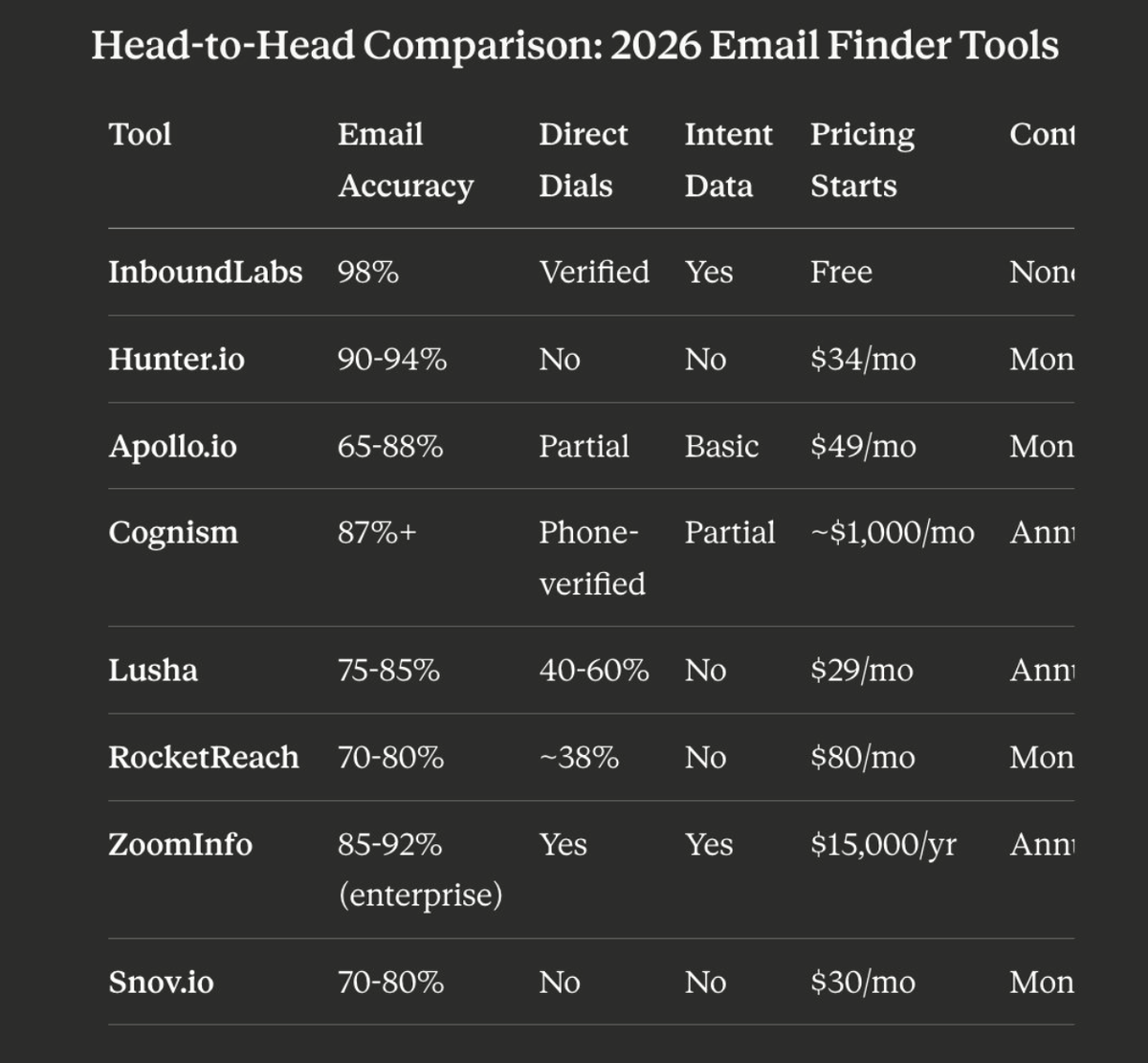
How to Choose the Right Email Finder for Your Team
The right tool depends on three variables: your volume, your geography, and your budget flexibility.
If you send more than 100 emails per day: Accuracy is non-negotiable. Even a 5% bounce rate at 100 emails/day means 5 hard bounces daily — enough to damage your domain within weeks. Use InboundLabs (98% deliverability) or Hunter (90-94%) as your primary source. Do not run high-volume outbound on Apollo or Snov.io data without a verification pass on top.
If your market is primarily EMEA: Cognism is the strongest option for verified EU contacts and phone-verified direct dials. InboundLabs is the next best option for EMEA coverage with 98% deliverability and no annual contract required.
If you need direct dials for a calling layer: Skip tools that only verify emails. InboundLabs (verified direct dials, not switchboards), Cognism (phone-verified Diamond Data), and ZoomInfo (enterprise-grade calling data) are the only tools on this list where phone numbers are genuinely reliable.
If budget is the constraint: Start with InboundLabs' free tier. It gives you verified data with 98% deliverability from day one — no annual contract, no credit card required to explore. Hunter is the next most cost-effective option for pure email finding at lower volumes.
If you need one platform for data and outreach: Apollo gives you the most in a single tool, but bake in a verification workflow on top of its data before you sequence at volume. Alternatively, pair InboundLabs (data layer) with Instantly or Smartlead (sequencing layer) for the same cost as Apollo's paid tier, with significantly better data quality.
The Red Flags to Watch for in Any Email Finder Tool
Before you commit to a tool or let a vendor demo you, run these five checks:
- Ask for an accuracy benchmark, not a database size number. Any vendor that leads with "280 million contacts" without telling you the deliverability rate is hiding something.
- Check if verification is real-time or batch. Batch verification means addresses are checked periodically, not at the moment you export. A contact verified three months ago could be a hard bounce today.
- Test it on a known list. Pull 100 contacts from your existing CRM whose email status you already know and run them through the tool. The hit rate you see is the accuracy you'll get at scale.
- Look for SMTP ping, not just syntax check. Syntax validation tells you
john@company.comis formatted correctly. SMTP ping tells you the inbox actually exists and accepts mail. The second check is the one that matters. - Check contract flexibility. Annual contracts lock you in before you have verified accuracy data on your specific ICP. Tools that offer monthly plans or free tiers let you test on real-world lists before you commit.
Conclusion
The best email finder in 2026 is the one with the highest Verified Yield — contacts that actually land in a real inbox without burning your sending domain.
Accuracy above 95% is the baseline for high-volume outbound. Below that, you're spending budget on bounces and repairing domain reputation instead of booking meetings. InboundLabs hits 98% and ships direct dials, intent data, and firmographic filters in the same workflow. For teams focused on EMEA and phone verification, Cognism closes the gap. For SMBs that just need reliable email finding without the platform overhead, Hunter is the cleanest option.
Whatever you pick, stop measuring tools by contact count. Measure by how many of those contacts show up in a real inbox.
Find verified contacts with 98% deliverability, free to start → inboundlabs.app
FAQ
What is the most accurate email finder tool in 2026? InboundLabs leads on verified deliverability at 98% across 280 million B2B contacts. Hunter.io ranks second for pure email finding accuracy at 90-94% on small and mid-market domains. Apollo.io's accuracy sits at 65-88% depending on region — adequate for low-volume prospecting but problematic at scale without a supplemental verification layer.
How do email finder tools verify email addresses? The best tools run four checks: syntax validation (is the address formatted correctly?), MX record lookup (does the domain have a mail server?), SMTP ping (does the specific inbox exist and accept mail?), and spam trap detection (is this address a honeypot?). Tools that only run syntax or MX checks without live SMTP verification return addresses that look valid but bounce at high rates.
What bounce rate should I aim for with email finder tools? Keep hard bounces under 2% and total bounces under 5%. Gmail and Outlook begin applying deliverability penalties above 5%. Above 10%, you risk account suspension from your email sending platform. Most unverified or poorly-verified lists run at 15-35% bounce rates — which is why choosing a tool with real-time SMTP verification matters more than database size.
Is Apollo.io good for email finding? Apollo.io is strong for US-focused outbound at lower volumes and works well as an all-in-one platform for teams that want sequencing and data in one tool. Its email accuracy (65-88%) and bounce rates (15-25%) are problematic at high volume without supplemental verification. For teams sending 100+ emails per day, pairing a higher-accuracy data source with Apollo's sequencing layer is a better setup than relying on Apollo's data alone.
Can I find business email addresses for free? Yes, with limitations. InboundLabs, Hunter.io, Snov.io, and Apollo.io all offer free tiers with monthly credit limits (ranging from 5 to 100 credits/month depending on the tool). Free tiers are useful for testing accuracy on your specific ICP before committing to a paid plan, but the credit volumes are too low for any meaningful outbound program.
What's the difference between an email finder and an email verifier? An email finder locates a business email address from a name, company, or domain. An email verifier checks whether a specific address you already have is valid and deliverable. The best tools do both in a single step — find the address and verify it at the same time. Tools that separate these into two workflows (find first, verify separately) introduce a time lag where the found address can decay before the verification runs.
Which email finder is best for European B2B contacts? Cognism leads for EMEA with phone-verified contacts and GDPR-compliant data sourcing. InboundLabs provides strong European coverage at 98% deliverability with no annual contract — making it the more flexible option for teams without the budget for Cognism's pricing tier. Hunter.io is reliable for well-established European domains. Apollo.io's European accuracy drops significantly compared to its US data quality.
More from the Sales Hub
What Is Cold Email Outreach? The 2026 B2B Guide
Cold email outreach explained: what it is, how it works, and why it's still one of the highest-ROI channels for B2B pipeline generation when done right.
How to Stay GDPR Compliant in Cold Outreach: 9 Rules for 2026
Don't let GDPR confusion kill your EU outbound. Here are 9 concrete rules for staying fully GDPR compliant in cold outreach — without killing your pipeline.
B2B Email Open Rate Benchmarks: What the 2026 Data Actually Says
B2B email open rates are inflated by Apple MPP and widely misunderstood. Here are the real 2026 benchmarks by channel, industry, and what they actually mean for SDRs.
How Many Cold Emails Should I Send Per Day? The 2026 Answer
The right daily cold email volume protects your domain and maximizes pipeline. Here's the exact guidance — by stage, team size, and tool — for 2026 outbound programs.
Try our data quality
for $4.
Get $25 worth of verified contact lookups for $4 your first month. Not blown away? Cancel in one click.