Lusha Alternatives in 2026: 7 Tools With More Data for Less
Lusha credits burn fast and the database is small. Here are 7 Lusha alternatives in 2026 with better coverage, verified direct dials, and fairer pricing for B2B sales teams.
Lusha is one of the more accessible B2B contact tools — affordable entry price, clean UI, LinkedIn integration. But its contact database sits at around 100M records, data accuracy gets inconsistent at scale, and the credit model gets expensive fast once your team starts pulling lists seriously. Here are seven alternatives that go further for comparable or lower cost.
Lusha built its reputation on one thing done really well: a Chrome extension that overlays direct mobile numbers and emails on LinkedIn profiles instantly. For SDRs who live in Sales Navigator, that's a genuinely useful workflow.
But as teams scale, Lusha's cracks become expensive. Credits burn fast — revealing a mobile number can cost 5–10x what a basic email costs. The database is smaller than competitors, meaning "No Data Found" shows up more often than you'd want. And outside North America, coverage drops sharply.
If you're paying for Lusha and hitting these walls, here are seven alternatives that solve the same problem with more coverage, better pricing, or higher accuracy.
Definition Box Lusha is a B2B contact data platform best known for its Chrome extension, which surfaces verified email addresses and direct mobile numbers while browsing LinkedIn profiles. It's popular with SDRs for its ease of use but has limitations in database size, credit model, and international coverage.
Why Teams Switch Away from Lusha
The complaints are predictable once you scale:
Credit system gets expensive fast. Lusha's pricing looks accessible at $29/user/month — until you realize that mobile numbers cost significantly more credits than emails, and monthly credits don't roll over. Teams doing 500+ lookups/month hit walls quickly.
Database coverage gaps. Lusha's contact database is smaller than Apollo, ZoomInfo, or Inbound Labs. For niche industries, smaller companies, or non-US markets, "No contact found" is a regular occurrence.
International data thins out. Lusha's strongest coverage is North America. EMEA and APAC data quality is noticeably weaker — a problem for any team with a global ICP.
It's one-trick. The LinkedIn extension is excellent. But Lusha doesn't have native sequencing, intent data, or firmographic filtering at the depth of full-stack competitors.
The 7 Best Lusha Alternatives in 2026
1. Inbound Labs — Best for Verified Direct Dials at Scale
Best for: SDR teams that need Lusha-quality mobile numbers without the per-credit burnout
The core appeal of Lusha is direct mobile numbers that actually reach people — not company switchboards. Inbound Labs delivers the same thing across a 280M contact database with 98% deliverability and no per-credit confusion eating into your monthly budget.
Where Lusha is primarily a LinkedIn extension workflow, Inbound Labs is a full prospecting platform — bulk list building, firmographic filtering, domain search, and direct dials — without needing to browse LinkedIn profile by profile.
The InboundLabs Prospecting Speed Advantage: SDRs using single-profile tools like Lusha average 40–60 enriched contacts per hour. With bulk list-building in Inbound Labs, the same rep can build a verified, direct-dial list of 500 contacts in under 30 minutes.
Key strengths:
- 280M verified contacts, 98% deliverability
- Direct mobile numbers — not switchboard routing
- Bulk list building without per-credit throttling
- Free to start, no credit card
Try InboundLabs free and start building your pipeline today → inboundlabs.app
2. Apollo.io — Best for All-in-One Outbound at Lusha's Price Point
Best for: Teams who want data + sequencing in one platform under $100/month
Apollo gives you a 275M+ database, email sequencing, a dialer, and CRM integrations for $49–$99/user/month — roughly what Lusha charges, but with significantly more capability. The free tier with database access makes it easy to test before committing.
The tradeoff versus Lusha: Apollo's mobile number accuracy is inconsistent, especially outside North America. If direct dials are your primary use case, Apollo underdelivers. For email-led outbound at volume, it's the better value.
Key strengths: All-in-one, affordable, great free tier, 275M+ contacts
Limitations: Mobile accuracy weaker than Lusha for direct dials
3. Hunter.io — Best for Email-Only Prospecting
Best for: Teams whose outbound is entirely email-based and need high deliverability above all
Hunter.io won't give you mobile numbers — that's not its product. But for finding and verifying business email addresses at scale, it consistently outperforms most tools including Lusha on pure email accuracy. Domain Search lets you pull all known emails at a company instantly.
At $49/month for 500 requests, it's significantly cheaper than Lusha for email-only workflows.
Key strengths: Best-in-class email accuracy, domain search, affordable
Limitations: No mobile numbers, limited firmographic data
4. Cognism — Best for EMEA Coverage and Phone-Verified Mobiles
Best for: European sales teams where GDPR compliance and phone verification quality are critical
If Lusha was your go-to for direct dials and you're hitting EMEA coverage gaps, Cognism is the strongest alternative. Their Diamond Data standard — where mobile numbers are manually verified by a human calling the number — delivers the highest phone accuracy in the industry.
The tradeoff: Cognism is priced at $5K–$10K+/year, significantly more than Lusha. For small teams, the jump isn't worth it. For mid-market and enterprise teams with EMEA as a primary market, it's justified.
Key strengths: Phone-verified Diamond Data, GDPR-compliant, strong EMEA
Limitations: Custom pricing, no self-serve, smaller database than Inbound Labs or Apollo
5. Seamless.AI — Best for Real-Time Contact Building
Best for: SDRs who want fresh data built in real-time rather than pulled from a static database
Seamless.AI generates contact records on the fly as you search, rather than querying a stored database. This means less staleness — the "person left 14 months ago" problem that costs reps time and credibility.
The Chrome extension integrates with LinkedIn like Lusha does, and direct dial accuracy for US contacts is generally better than Apollo. Coverage outside North America remains a limitation.
Key strengths: Real-time verification, strong US direct dials, LinkedIn integration
Limitations: Gets expensive at high volume, weaker international data
6. RocketReach — Best for Finding Contacts at Specific Companies
Best for: AEs doing targeted account research who need to find the right person at a specific company
RocketReach excels at one specific workflow: you know the company you want to target, you need to find the right contact and their details. Its search by company + job title is fast and reliable, with coverage across 700M+ profiles.
It's not as strong for building broad prospect lists or bulk enrichment, but for focused account-based prospecting it outperforms Lusha on database depth.
Key strengths: Large database (700M+ profiles), strong for account-level research
Limitations: Credit model, weaker for bulk list building, limited sequencing
7. UpLead — Best for Low Bounce Rate and Clean Lists
Best for: Teams focused on email deliverability who want a credit-back guarantee
UpLead verifies every email in real-time at the point of export and offers credits back for any bounced contacts. If Lusha's data quality has been causing deliverability headaches, UpLead's accuracy guarantee is a meaningful alternative.
Key strengths: Real-time email verification, credit refund for bounces, transparent pricing
Limitations: Smaller database than Apollo, no Chrome extension like Lusha
Quick Comparison
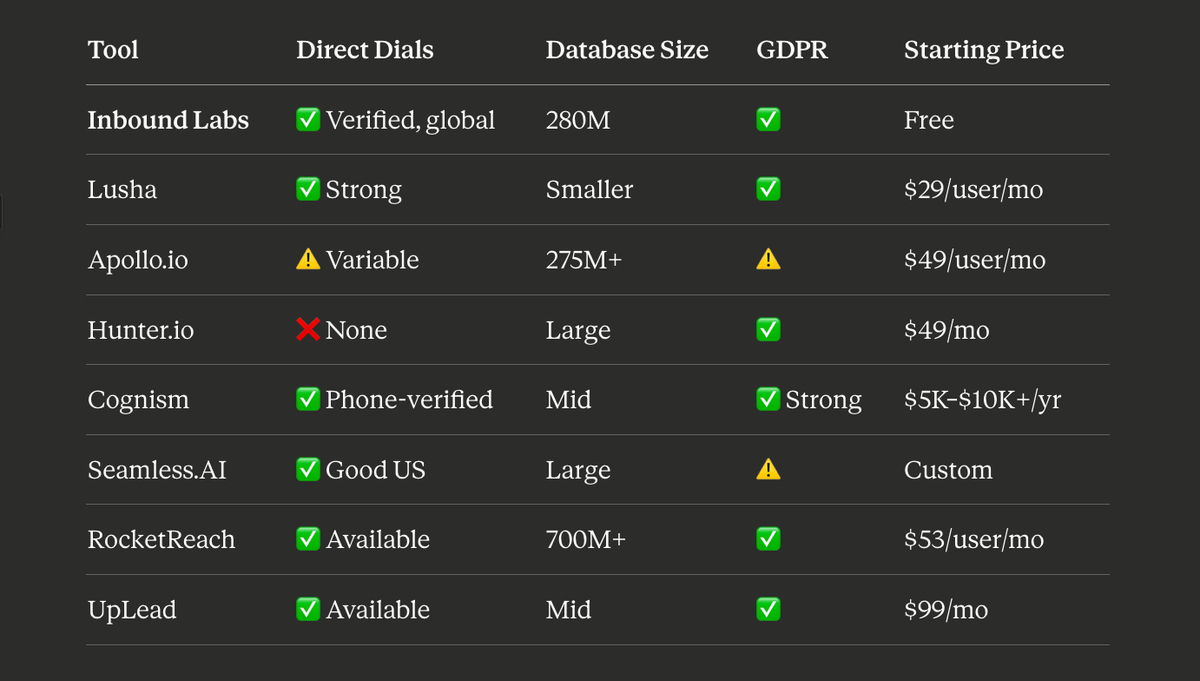
Which Lusha Alternative Is Right for You?
- Need Lusha's direct dial quality but at scale without per-credit throttling? Inbound Labs — 280M contacts, bulk building, 98% deliverability.
- Want everything in one tool at a similar price? Apollo covers data + sequencing for what Lusha charges for data alone.
- EMEA-focused and compliance is critical? Cognism is the premium option.
- Email-only outbound? Hunter.io saves you money and outperforms on deliverability.
- Account-based, company-specific research? RocketReach's 700M+ database.
Conclusion
Lusha is a well-designed tool for a specific workflow: LinkedIn-based, contact-by-contact prospecting with a clean Chrome extension. But if you're building lists at scale, targeting outside North America, or tired of credits evaporating before month-end, you've outgrown it.
Inbound Labs gives you the same verified direct-dial quality across a 280M contact database — with bulk list building, no credit confusion, and a free tier to test your ICP before committing.
For related comparisons, see our ZoomInfo alternatives roundup and the best email finder tools guide.
Common Questions About Lusha Alternatives
Is Lusha accurate for direct dials?
Lusha's mobile number accuracy is above average for North American contacts — it's one of the reasons for its popularity. Outside the US and Canada, accuracy drops. For global coverage with comparable quality, Inbound Labs and Cognism both outperform Lusha internationally.
Why do Lusha credits run out so fast?
Lusha uses a tiered credit system where mobile numbers cost significantly more credits than email addresses. On the $29/month plan, heavy users can exhaust credits in the first week. Credits also don't roll over, so unused credits at month-end are lost.
Does Lusha work without LinkedIn?
Lusha's primary product is its LinkedIn Chrome extension. It does have a standalone platform for searching contacts directly, but the LinkedIn workflow is where it delivers the most value. For non-LinkedIn prospecting, Inbound Labs or Apollo offer more versatile bulk search.
Is Lusha GDPR compliant?
Yes, Lusha is GDPR and CCPA compliant and maintains a DNC suppression list. However, for teams that need full compliance documentation and the highest assurance level, Cognism's compliance infrastructure is more comprehensive.
What's cheaper than Lusha with similar mobile number quality? Inbound Labs offers verified direct dials across a larger database at a lower effective cost per contact — particularly for teams doing bulk outreach rather than one-by-one LinkedIn lookups.
Can I use Lusha for bulk list building? Technically yes, but it's not Lusha's strength. The per-credit cost for bulk mobile lookups makes it expensive fast. Tools like Inbound Labs or Apollo are better suited for building prospect lists of hundreds or thousands of contacts.
Last updated: April 2026
Also see: 7 Apollo.io alternatives in 2026 — a similar comparison for teams evaluating Apollo alongside Lusha.
More from the Sales Hub
Wappalyzer Alternatives: 7 Tools Compared (2026)
What is a Wappalyzer alternative? A Wappalyzer alternative is any tool that identifies the technologies a company uses, with many also adding contact data, firmographics, or intent signals on top. Pure detection tools (like BuiltWith) scan websites for front-end technologies. Full sales intelligence platforms layer those signals onto verified B2B contacts so you can act on the data immediately.
BuiltWith Alternatives in 2026: 6 Tools Actually Tested
BuiltWith is a server-side web crawler that identifies the technologies, analytics tools, hosting providers, and frameworks detected on any website. It maintains a database of over 50,000 technologies across millions of domains and provides historical adoption data showing when companies added or dropped specific tools. It is the most comprehensive technology coverage database available for B2B sales teams doing technographic segmentation.
Funding Data API: The Funding Signal Latency Guide
What is a funding data API? A funding data API provides structured access to investment event data: company name, funding stage, round size, lead investors, and close date. Sales and RevOps teams use it to trigger outreach automatically when target accounts receive capital, since funded companies have confirmed budget and the mandate to spend it.
B2B Data Coverage Rates: What They Mean and What's Good
B2B data coverage rate is the percentage of your target account list or ICP for which a data provider can return at least one qualifying contact matching your title, seniority, and role criteria. It's distinct from total record count (how many contacts a provider holds overall) and from accuracy (what percentage of returned contacts have valid, deliverable contact details).
Try our data quality
for free.
No commitment. No credit card. Just 50 free verified contact lookups.