ZoomInfo Alternatives in 2026: 7 Tools That Cost Less and Deliver Better Data
ZoomInfo starts at $15K/year with no free trial, auto-renewing contracts, and data accuracy around 75–85%. Here are 7 alternatives enterprise sales teams are switching to in 2026.
ZoomInfo has been the dominant name in B2B sales intelligence for years. And if you're reading this, you've likely already seen the quote — somewhere between $15,000 and $40,000 per year, annual contract only, three-seat minimum, no free trial, and an auto-renewal clause that locks you in for another year if you miss the cancellation window by a single day.
That's the ZoomInfo experience for thousands of sales teams in 2026. The brand is strong. The database is real. But the pricing model, data accuracy gaps, and contract rigidity have pushed a growing number of teams to look elsewhere.
The good news: the alternatives market has matured significantly. You no longer have to choose between ZoomInfo's price tag and poor data quality. Here are seven ZoomInfo alternatives worth evaluating in 2026, starting with the best option for enterprise teams that need verified direct mobile numbers.
Why Teams Are Leaving ZoomInfo in 2026
Before getting into alternatives, it helps to understand what the actual pain points are — because the right alternative depends on which of these is hitting your team hardest.
Price. ZoomInfo's median annual contract runs around $31,875 based on verified buyer data, and that's before per-seat add-ons ($1,500–$2,500/user), intent data upgrades, and credit overage fees. For enterprise teams this may be justifiable. For everyone else, it's often 80% of budget spent on 20% of what they actually need.
No flexibility. There's no monthly billing, no free tier, no self-serve option. Every deal goes through a sales rep, pricing is opaque, and once you're in, you're locked. Miss the 60-day cancellation window and you're committed for another full year at potentially higher rates.
Data quality gaps. ZoomInfo claims 95%+ accuracy. Real-world user reports put email accuracy at 75–85%, with phone numbers — particularly outside North America — frequently routing to receptionists or former employees. On Trustpilot, ZoomInfo scores 1.6 out of 5, a significant contrast to its 4.5 on G2.
The data destruction clause. When your ZoomInfo contract ends, you're contractually required to delete all exported data from your systems. The contacts you've built pipeline on don't come with you.
With that context, here are the alternatives.
1. Inbound Labs — Best for Verified Direct Mobiles + High Deliverability
Best for: Enterprise SDR teams where reaching a human directly — not a switchboard — is the core of their outbound motion
If ZoomInfo's mobile number accuracy has been the frustration (contacts that route to receptionists, numbers for people who left 18 months ago), Inbound Labs is built to solve exactly that problem.
With 280M verified B2B contacts and 98% deliverability, Inbound Labs focuses on what matters most in outbound: data you can actually use without scrubbing first. No annual contracts forcing you into six-figure commitments. No opaque credit systems that surprise you mid-campaign.
For enterprise teams that need direct mobile numbers at scale — not just email addresses — and want a platform they can start using without a procurement process, Inbound Labs is the strongest starting point.
Key strengths:
- 280M verified contacts, 98% deliverability
- Direct mobile numbers, not switchboard routing
- No ZoomInfo-style contract lock-ins
- Free to start — no credit card required
Try it: inboundlabs.app
2. Apollo.io — Best for All-in-One Outbound on a Budget
Best for: Startups and SMBs who want a data + sequencing platform without a five-figure annual contract
Apollo is the most popular ZoomInfo alternative for teams where budget is the primary constraint. At $49–$99/user/month with a usable free tier, it undercuts ZoomInfo by 70–80% on price. The platform combines a 275M+ contact database with email sequencing, a dialer, and basic CRM features — replacing several tools at once.
The tradeoff is data accuracy. Apollo's real-world email accuracy lands around 65–80%, and mobile number quality is inconsistent — especially outside North America. Bounce rates of 15–25% are commonly reported, which is above the industry threshold of under 5%.
Key strengths: Affordable, all-in-one, strong free tier, transparent pricing
Limitations: Data accuracy below ZoomInfo, mobile number quality hit-or-miss
3. Cognism — Best for EMEA and GDPR-Compliant Teams
Best for: Sales teams targeting the UK, Europe, or any market where GDPR compliance is non-negotiable
Cognism is widely regarded as the strongest ZoomInfo alternative for European markets. Their "Diamond Data" standard means mobile numbers are manually phone-verified by a human team — so when you dial, the number actually rings. A recent Forrester Wave report ranked Cognism higher than ZoomInfo specifically on contact data quality.
Pricing is custom and sits in the mid-market range ($5K–$10K+), making it significantly cheaper than ZoomInfo while maintaining strong data quality. The platform also checks data against 15 global Do Not Call lists, making it one of the safest options for GDPR-regulated outreach.
Key strengths: Phone-verified mobiles, GDPR-compliant, strong EMEA coverage
Limitations: Pricing is creeping upward, smaller US database than ZoomInfo
4. Lusha — Best for LinkedIn Prospecting Workflows
Best for: SDRs who live in LinkedIn Sales Navigator and need direct-dial numbers on the fly
Lusha's core product is a Chrome extension that overlays contact data directly on LinkedIn profiles. Visit a profile, click the button, get a verified email and often a direct-dial mobile number — no complex workflows, no 47 features to learn. It's the simplest tool on this list by design.
Mobile coverage is Lusha's strongest suit, particularly for finding personal mobile numbers that other tools miss. Plans start around $29/user/month, making it accessible for smaller teams. The main limitation is database size — for niche industries or non-US markets, "No Data Found" shows up more often than you'd want.
Key strengths: Chrome extension, mobile number accuracy, ease of use
Limitations: Smaller database, credits burn fast for heavy users
5. UpLead — Best for Teams Prioritizing Low Bounce Rates
Best for: Sales teams that have been burned by high bounce rates and want an accuracy guarantee
UpLead positions itself as the anti-ZoomInfo — quality over quantity. The platform offers real-time email verification at the point of export, meaning every contact you pull has been checked against the mail server before it hits your CRM. They back this with a credit-return policy for any bounced contacts.
This makes UpLead a strong choice for teams where sender domain reputation is the primary concern. It won't give you ZoomInfo's database breadth or intent data depth, but for straightforward contact prospecting with minimal bounce risk, the accuracy guarantee is compelling.
Key strengths: Real-time verification, credit-back policy, transparent pricing
Limitations: Smaller database, limited intent data, less suitable for enterprise scale
6. Seamless.AI — Best for Real-Time Data at Scale
Best for: High-volume outbound teams that need continuously refreshed data
Seamless.AI functions as a real-time search engine for contacts rather than a static database. Instead of pulling from records last updated months ago, it builds contact data in the moment using AI — which reduces staleness and the "former employee" problem that ZoomInfo users frequently report.
The Chrome extension integrates with LinkedIn and major CRMs, and the platform is well suited for teams doing high-volume prospecting (500+ contacts/month). Users consistently cite better direct dial accuracy compared to Apollo, though it varies by market.
Key strengths: Real-time data building, direct dial focus, high volume support
Limitations: Credit model gets expensive at scale, smaller overall database than ZoomInfo
7. Lead411 — Best for Intent-Driven Prospecting
Best for: Enterprise teams that want to prioritize outreach based on buying signals, not just contact lists
Lead411 combines verified B2B contact data with Bombora intent data — tracking signals like job changes, funding announcements, and hiring surges that indicate a company is actively in a buying window. This lets sales teams focus their highest-effort outreach on accounts most likely to convert, rather than blasting a cold list.
Month-to-month subscriptions with no annual contract requirement make it the most flexible enterprise-grade option on this list. And unlike ZoomInfo, there's no data destruction clause — your exported contacts stay with you when you leave.
Key strengths: Intent data, no annual contract, unlimited exports, no data destruction
Limitations: Smaller database than ZoomInfo or Apollo, less name recognition
How These Tools Compare at a Glance
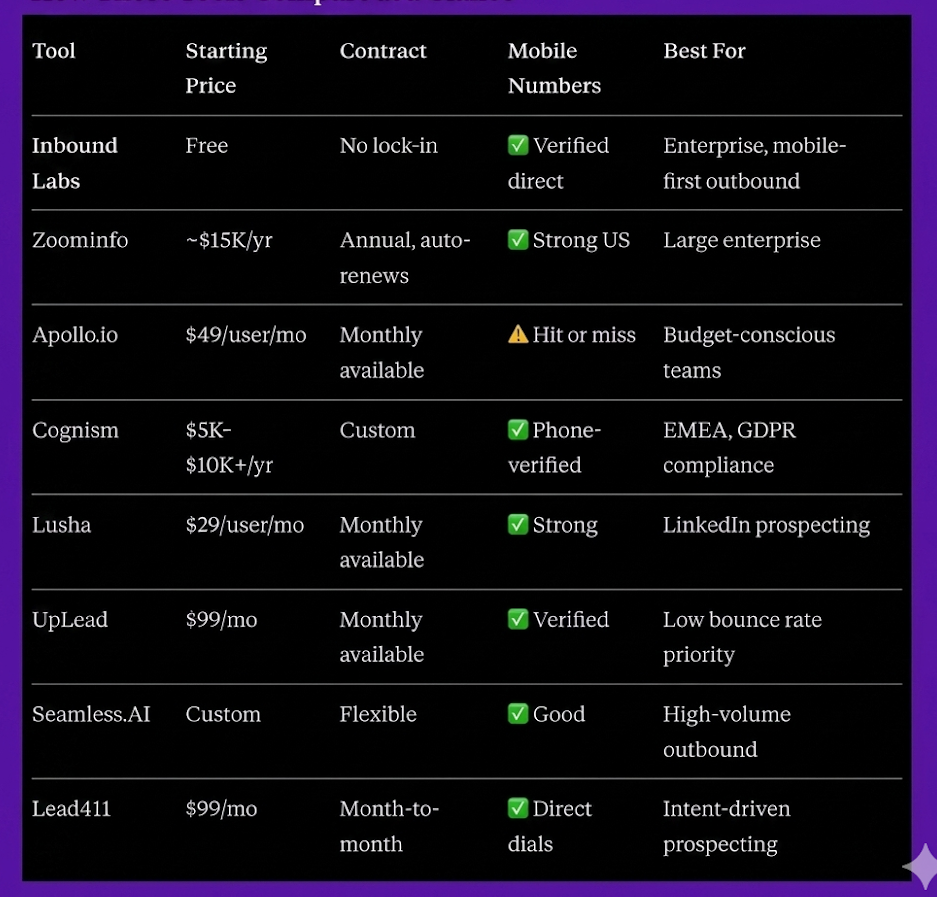
Which One Should You Choose?
The right ZoomInfo alternative depends entirely on where the pain is:
- ZoomInfo's price is the issue → Apollo or Inbound Labs. Both offer free tiers and no mandatory annual contracts.
- Mobile number accuracy is the issue → Inbound Labs (98% deliverability, verified direct mobiles) or Cognism (phone-verified Diamond Data).
- You're targeting Europe → Cognism leads for EMEA coverage and GDPR compliance.
- Bounce rates are tanking your domain reputation → UpLead's real-time verification or Inbound Labs' 98% deliverability threshold.
- You need intent signals alongside contact data → Lead411 with Bombora integration.
- You live in LinkedIn → Lusha's Chrome extension is the fastest workflow.
One thing almost all ZoomInfo alternatives have in common: free tiers or trials. Use them. Running your actual ICP through a tool for two weeks tells you more than any feature comparison chart.
The Bottom Line
ZoomInfo is a capable platform for large enterprises with the budget, procurement bandwidth, and North American focus to justify it. For most other teams in 2026, the value equation no longer holds up — particularly given that several alternatives now match or exceed ZoomInfo's data quality in specific use cases, at a fraction of the price.
If direct mobile access and email deliverability are your core requirements, Inbound Labs is the sharpest starting point — 280M verified contacts, 98% deliverability, no contract, free to start.
Also see: ZoomInfo pricing breakdown — the real cost with hidden fees, before you decide to stay or switch.
More from the Sales Hub
Apollo.io Alternatives in 2026: 7 Tools with Better Data Accuracy for Enterprise Sales Teams
Apollo.io Alternatives in 2026: 7 Tools With Better Data Accuracy
ChatGPT Prompts for Sales Prospecting (6 Templates)
What makes a good sales prospecting prompt? A high-quality sales prompt specifies a role for the AI, provides ICP context, sets constraints (tone, length, banned phrases), and defines the exact output format needed. Without all four, output quality is unpredictable.
What Is an AI SDR? The 2026 Complete Guide
What is an AI SDR? An AI SDR is software that automates top-of-funnel sales tasks including contact research, account targeting, email writing, and outreach sequencing. It operates without human input on each individual step, scaling prospecting efforts across thousands of contacts at once.
AI SDR vs Human SDR: How to Use Both
What is an AI SDR? An AI SDR is a software agent that automates the research, outreach, and follow-up stages of B2B prospecting. It sources contacts, writes personalised emails, sends sequences, classifies replies, and routes positive responses to human reps. As of 2026, the best AI SDRs can take a prospect from cold list to booked meeting without human input, though quality depends heavily on the underlying contact data.
Try our data quality
for free.
No commitment. No credit card. Just 50 free verified contact lookups.